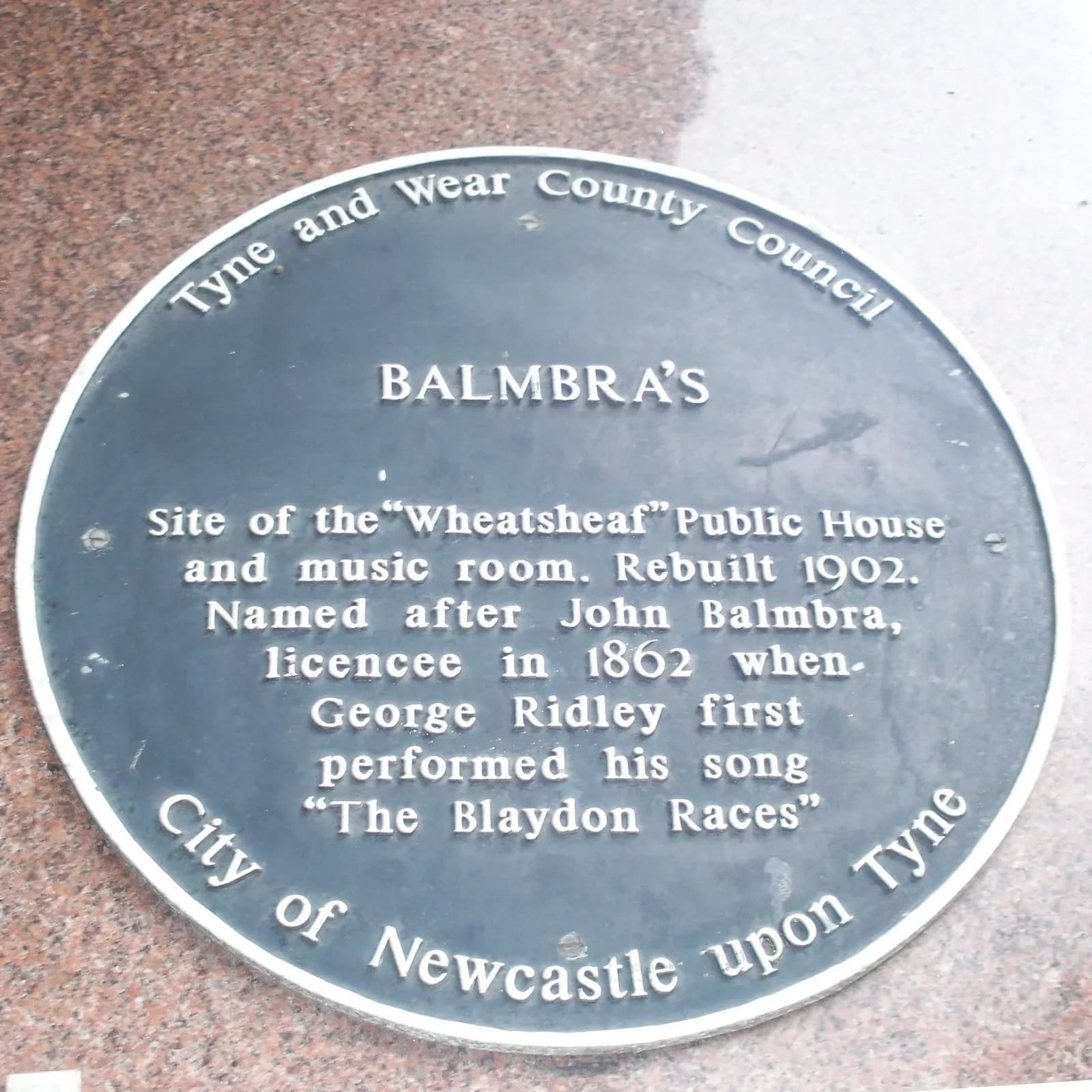
Born in a Newcastle music hall and inspired by a rain-soaked day of horses, fairground attractions, industrial smoke and public disorder, The Blaydon Races has become far more than a comic Victorian song. It is a musical map of nineteenth-century Tyneside and one of the strongest surviving expressions of Geordie identity.
On Monday 9 June 1862, thousands of people poured westwards out of Newcastle.
Some travelled by train. Others squeezed into horse-drawn omnibuses, carts and whatever other transport could be found. They were heading towards Blaydon, where a day of horse racing, drinking, dancing, fairground entertainment and general commotion awaited them beside the River Tyne.
The weather was dreadful. Heavy rain turned the ground to mud and caused the river to rise. The horses expected to compete on Blaydon Island struggled to reach the course, and when the racing was supposed to begin, only one horse was reportedly present. The crowds, however, had arrived in force.
It was exactly the kind of day that Tyneside would remember.
Its permanent memorial was not a newspaper report or official painting, but a raucous music hall song filled with broken wheels, injured passengers, local celebrities, industrial landmarks and broad Geordie dialect.
That song was The Blaydon Races.
The miner who found his voice
George Ridley was born in Gateshead on 10 February 1835. His early life reflected the harsh realities faced by many working-class children on nineteenth-century Tyneside.
At about eight years old, he was sent underground as a trapper boy at Oakwellgate Colliery. A trapper sat in darkness beside a ventilation door, opening and closing it as coal tubs passed. It was monotonous, dangerous work performed by children who were often too young for heavier mining duties.
Ridley later worked at the Goose Pit before finding employment as a wagon rider with Hawks, Crawshay and Company, one of Gateshead’s major industrial concerns. There, according to the most detailed surviving biographical accounts, he was crushed by a runaway wagon and left unable to continue strenuous manual labour.
The accident is sometimes loosely described as a mining injury, and some modern accounts place it at Garesfield Colliery. The stronger biographical evidence, however, connects the disabling accident to his industrial employment at Hawks, Crawshay and Company after his years underground.
For a working man with limited formal education, serious injury could mean destitution. Ridley instead turned towards entertainment.
He began writing comic songs, performing character sketches and appearing in the growing network of concert rooms and music halls around Newcastle and Gateshead. These included Grainger Music Hall, the Tyne Concert Hall and Balmbra’s Music Hall, which stood near Newcastle’s Cloth Market and Bigg Market.
Ridley became known for songs rooted in the speech, personalities and everyday experiences of Tyneside. His humour belonged to the streets, workshops, public houses and pit communities around him. Nineteen songs have been attributed to him, with sixteen known to survive. They include local favourites such as Cushie Butterfield, Johnny Luik-Up the Bellman and Joey Jones.
His career was tragically brief. Ridley died on 9 September 1864, aged just 29, little more than two years after introducing the song that would define him. He never lived to witness its transformation into a regional anthem.
A song performed before the journey happened
The Blaydon Races was first performed at Balmbra’s Music Hall on Thursday 5 June 1862, four days before the race meeting described in its most famous verse.
Ridley presented it during a testimonial concert for John H. Clasper, a celebrated local rower and member of the famous Tyneside rowing family. The song helped advertise the forthcoming races while giving Ridley an opportunity to fill a familiar local journey with accidents, arguments and recognisable characters.
This date reveals an important point. The chaotic omnibus journey was not a straightforward eyewitness account of something that happened on 9 June. It was a comic fiction written in advance, although it was based on an authentic route, genuine locations and the kinds of transport problems associated with crowded race days.
After the actual races, Ridley appears to have added or adapted the concluding material to reflect the terrible weather and the difficulties getting the horses onto the island. He performed the song again during an evening concert at the Whickham Mechanics’ Institute in Blaydon, where contemporary reporting said the entertainment was received with great applause.
The melody was not original. Ridley borrowed it from On the Road to Brighton, an American song associated with the nineteenth-century minstrel stage.
That origin deserves acknowledgement. American minstrelsy was deeply connected to racist blackface entertainment, even as its tunes travelled internationally and were repeatedly given new local lyrics. Ridley’s achievement lay in taking an existing melody and completely relocating it within the geography, language and working-class culture of Tyneside. The tune crossed the Atlantic, but the story attached to it became unmistakably Geordie.
The road from Newcastle to Blaydon
The song begins near Balmbra’s, in the crowded commercial heart of Newcastle.
From the Cloth Market, the imaginary omnibus works its way through the city centre, passing along streets including Mosley Street, Collingwood Street and Neville Street. It then heads west towards the old Newcastle Infirmary and the road running beside the Tyne.
For modern listeners, the place names can sound like a cheerful geographical roll call. In 1862, however, they carried powerful associations.
Central Newcastle had been dramatically reshaped during the previous decades through the work of developers and architects such as Richard Grainger and John Dobson. Monumental new streets, markets and public buildings projected Victorian prosperity. Beyond the centre, the districts of Elswick, Benwell and Scotswood were becoming part of one of Britain’s most important industrial landscapes.
Travelling west, Ridley’s passengers would have passed the expanding Elswick Works established by William Armstrong. The factory produced hydraulic machinery, cranes, engines, bridges, guns and other heavy engineering products. It had begun on a relatively small site in 1847 but grew rapidly, helping to transform the riverside into a landscape of furnaces, workshops, railway lines, chimneys and densely packed housing.
The journey therefore ran through the physical heart of industrial Tyneside. Smoke, machinery and workers’ homes stood beside public houses, railway infrastructure and stretches of riverbank. Ridley’s comedy was taking place against a backdrop of enormous technological change.
From Scotswood Road, the party passed familiar landmarks and drinking places before approaching the Chain Bridge. This suspension bridge, opened in 1831, carried traffic across the Tyne between Scotswood and Blaydon. Travellers paid a toll before entering Blaydon and continuing towards the riverside raceground.
The route mattered because audiences knew it intimately. Every turn carried the possibility of recognition. Listeners could picture the streets, imagine the omnibus struggling through traffic and anticipate the public houses where passengers might disappear.
The song turned an ordinary local road into a communal stage.
When the wheel came off
Ridley’s fictional excursion becomes increasingly disastrous.
The crowded omnibus is uncomfortable from the beginning. Passengers quarrel, drink and complain. The horses struggle. Somewhere along the road, a wheel comes off, tipping passengers into confusion and causing injuries.
The comedy is physical and immediate. People are thrown together regardless of respectability. Men, women, doctors, drinkers and local celebrities become part of the same moving spectacle.
Behind the humour was a genuine public concern. After the 1862 meeting, the Newcastle Daily Chronicle criticised the condition of some race-day transport and suggested that omnibus companies should use better horses if they wished to protect their passengers.
Ridley exaggerated the danger for entertainment, but his audience would have recognised the underlying reality. Race days placed enormous pressure on a transport system still dependent on animals, crowded carriages and poorly maintained roads.
More than a horse race
The original Blaydon Races had roots reaching back to the early nineteenth century. Racing took place in the area by 1811, although railway construction later disrupted the original course.
The event was revived in 1861 on Blaydon Island, also known as Dent’s Meadow, a low-lying piece of land in the Tyne. A roughly circular track was created there, with horses competing while spectators gathered around the riverside.
The meeting was never only about serious racing. It was also a popular holiday for working people from Newcastle, Gateshead, Blaydon and the surrounding industrial communities. There were booths, food sellers, drink, dancing, performers, games and travelling amusements. Later artistic depictions show a dense mixture of horses, spectators, vendors, musicians and fairground attractions.
Respectable Victorian observers often complained about drunkenness, gambling and disorder at such gatherings. For many labouring families, however, race day offered an escape from the routines of mines, factories and domestic work. It was noisy, muddy, crowded and occasionally dangerous, but it belonged to the people who attended it.
The island course survived only briefly. Improvements and dredging along the Tyne eventually caused the island itself to disappear. Horse racing was revived at Stella Haugh in the late 1880s, but that later version ended during the First World War after serious unrest surrounding a disputed result.
The sporting event disappeared. The song did not.
Coffee Johnny and the characters of Tyneside
Part of the enduring appeal of The Blaydon Races comes from its cast of recognisable local figures. Ridley populated his song with people whose names would have prompted immediate reactions from a nineteenth-century audience.
The most famous is Coffee Johnny, whose real name was John Oliver.
Oliver was a Winlaton blacksmith known for his immense height, powerful build and distinctive white top hat. He was said to stand well over six feet tall and became one of the region’s great nineteenth-century folk characters. He also fought as a bare-knuckle boxer, including a lengthy contest against William Renwick in 1850.
The origins of his nickname remain uncertain, although various stories connect it to his fondness for coffee or incidents from his working life. What matters is that by the time Ridley wrote the song, Coffee Johnny was instantly recognisable. Placing him at the races gave the audience the pleasure of seeing a local celebrity enter the story.
Another figure is Dr Charles John Gibb, whose surname was sometimes rendered as Gibbs in printed lyrics.
Gibb was a respected Newcastle physician who served during the city’s devastating cholera outbreak of 1853 and later worked as an honorary surgeon at Newcastle Infirmary. In the song, his appearance after the omnibus accident adds another layer of local authenticity. Ridley was not inventing a generic comic doctor. He was naming a man his audience knew.
The lyrics also mention Jackie Broon, or Jackie Brown, Blaydon’s bellman and town crier. His job was to walk through the streets ringing a handbell before delivering public announcements. The bell associated with him has been preserved, and the historic object has even been used to start the modern Blaydon road race.
One frequently repeated modern account refers instead to “Jackie Butterwick” and describes his wife preventing him from escaping for a drink. That character does not appear in the authenticated published lyrics. The documented figure is Jackie Broon. The Butterwick name may have become attached to the story through later oral retelling or confusion with another of Ridley’s songs, Cushie Butterfield, but the anecdote should not be presented as established history.
Ridley’s use of real people makes the song resemble a musical snapshot of Tyneside. To sing it in the 1860s was to recognise neighbours, public figures, local eccentrics and familiar types.
Today, many listeners no longer know who those people were. Their names survive because Ridley placed them inside a chorus that communities continued to sing.
Why the dialect matters
The Geordie language of The Blaydon Races is not decorative. It is essential to the song’s identity.
Ridley wrote in forms that represented the pronunciation and vocabulary of local speech. Words such as gan, gannin, alang, toon, hyem and cuddy allowed audiences to hear their own voices from the stage.
Victorian popular entertainment frequently used regional dialect for comedy, sometimes presenting working-class speakers as crude or foolish. Ridley’s writing is more complicated. His characters are certainly comic, but the dialect also establishes authority. This is Tyneside describing itself rather than being described from outside.
The verses are delivered by a storyteller recounting his own adventure. The chorus then expands the experience into a collective one, addressing the “lads and lasses” and inviting everyone to join the journey.
That shift helps explain why the song became an anthem. An individual story becomes a shared memory. People who never travelled on an omnibus in 1862 can still place themselves inside the crowd. Academic analysis of the song has similarly identified its inclusive language and collective performance as important to its development from music hall entertainment into a statement of regional identity.
Singing in dialect also protects something vulnerable. Streets change, bridges disappear and industries close, but the sounds of a place can survive in music.
From the music hall to St James’ Park
As the original races faded from memory, the song travelled into public houses, community gatherings, political meetings, military bands and sporting crowds.
Its adoption by Newcastle United supporters gave it a new emotional scale. Thousands of voices could now perform together what Ridley had once sung from a music hall stage.
At St James’ Park, The Blaydon Races became one of the club’s defining anthems. It has been sung before matches, during major cup occasions and at moments when supporters want to assert the bond between the football club and the wider region.
The setting could hardly be more appropriate. The song begins in central Newcastle and travels through the communities from which generations of United supporters have come. Its refrain does not simply express loyalty to a team. It calls up an entire local landscape.
Newcastle United itself describes the song as an iconic anthem. In 2025, the pre-match order was adjusted so that it could accompany the players’ entrance more directly, while Mark Knopfler’s Local Hero remained part of the wider build-up.
The song also entered Newcastle’s rugby culture. At Kingston Park, the club historically known as Newcastle Falcons has used it as a changing-room victory song.
The club was renamed Newcastle Red Bulls following Red Bull’s takeover in 2025, but coaches and players have continued to refer publicly to singing The Blaydon Races after victories. The name above the door may change, but the ritual remains tied to the region.
Its survival across football and rugby shows that the song belongs to more than one institution. Clubs borrow its power because the cultural identity it represents is older and broader than any particular sporting organisation.
The Blaydon Race begins again
In 1981, Dr James Dewar of Blaydon Harrier and Athletic Club helped create a new race inspired by Ridley’s song.
This time, the competitors would travel on foot.
The first modern Blaydon Race attracted 212 runners. It grew into one of the North East’s most distinctive annual sporting events, with thousands now competing and places regularly selling out. It is held on 9 June, preserving the date of the Victorian race meeting.
The modern course follows the historic westward journey as closely as contemporary roads and safety requirements permit. Runners travel from Newcastle towards Blaydon, passing along the Tyne corridor and crossing the river before reaching the finish.
Some descriptions still state that the race begins on Collingwood Street and covers 5.7 miles. That is no longer accurate. The current official route is approximately 5.9 miles and begins on Newcastle’s Quayside before heading through Sandhill, Skinnerburn, Scotswood Road and across Scotswood Bridge towards Blaydon.
The exact streets have changed, but the direction of travel remains the same.
At the start, runners sing Ridley’s song. At the finish, they receive a characteristically local welcome. The event combines serious competition with fancy dress, community participation and a sense of historical theatre.
The bell once associated with Blaydon’s nineteenth-century town crier has also been used to send runners on their way, connecting the modern race physically as well as symbolically to the world Ridley described.
An anthem made by repetition
The Blaydon Races has lasted because every generation has found a new reason to sing it.
For Ridley’s first audience, it was topical comedy about an approaching day out. For later Tynesiders, it became a reminder of vanished streets, industries and local characters. Football and rugby supporters turned it into a declaration of collective loyalty. Runners transformed the imaginary omnibus journey into a physical challenge repeated every June.
It does not preserve 9 June 1862 with perfect documentary accuracy. That was never its purpose. The broken wheel belongs to comic fiction. Some details were exaggerated, altered through oral tradition or simplified as the song passed between generations.
Its deeper truth lies in the world it captures: a working population moving through an industrial landscape towards a day of freedom, excitement and possible disaster.
George Ridley lived for only 29 years. He began underground as a child, suffered an injury that ended his manual career and survived by making people laugh. Yet the voice he created has carried far beyond the music halls he knew.
More than 160 years later, Tyneside is still travelling with him.
Image: Site of the Former Wheatsheaf Public House, Where George Ridley First Performed “The Blaydon Races” - Bolckow, via Wikimedia Commons, CC BY-SA. Photo taken 1 January 2007.